Virtual agents are changing the way organizations communicate, support, and sell. Powered by advances in artificial intelligence (AI) and natural language processing (NLP), these digital assistants are now capable of handling complex conversations, resolving customer issues, and guiding users through processes with impressive accuracy and speed. Read about AI in a call center in the Apsense.com Guide to AI for Contact Centers to understand how virtual agents can optimize operations and enhance the customer experience.
Beyond traditional call center functions, virtual agents are increasingly integrated with cloud computing and AI-powered infrastructure, allowing businesses to scale efficiently while maintaining secure, high-performance tech systems. Using modern computer technology and AI-driven automation, companies can streamline workflows in multiple areas, including marketing with AI to personalize campaigns, digital marketing using AI for social media engagement, and financial operations powered by AI for faster transaction processing.
Virtual agent also support AI-based customer experience strategies, automated business intelligence, and predictive analytics for decision-making, making them essential for organizations seeking smarter, more responsive operations. By combining cloud AI solutions, intelligent marketing automation tools, and AI-assisted business processes, virtual agents transform from simple chatbots into central platforms that improve efficiency, enhance user experiences, and drive measurable growth.
This guide unpacks what virtual agents are, how they work, and—most importantly—how they can drive real, measurable value for your business.
Top 10 Contact Center Solutions with Virtual Agents
Virtual agents are transforming customer support, sales, and engagement in contact centers. Organizations seeking advanced AI-driven contact center solutions have many options, but some providers stand out for their technology, scalability, and AI integration. Here are the top 10 contact center solutions to consider.
1. Bright Pattern: AI Contact Center Solution
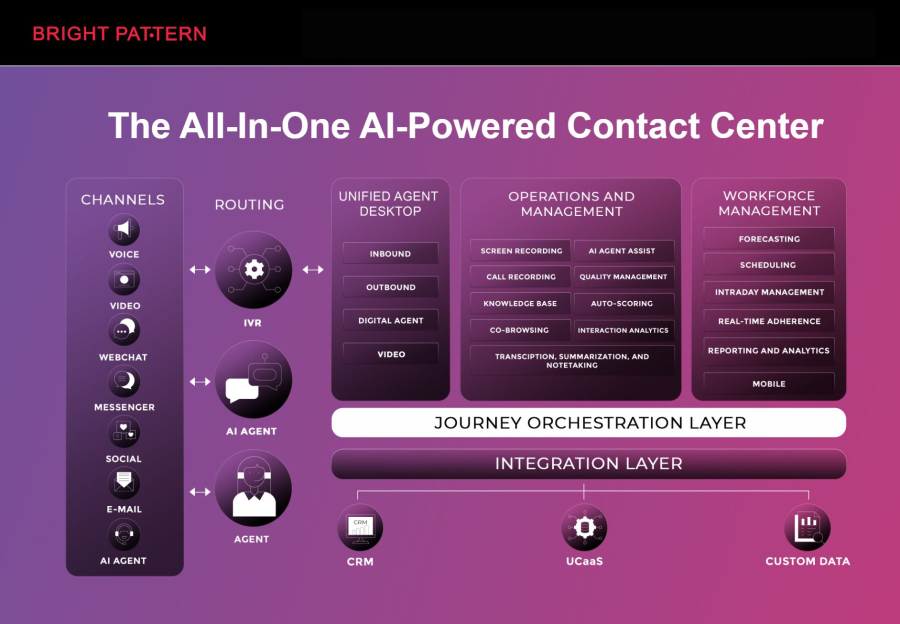
Bright Pattern leads the market with its intelligent virtual agent capabilities and comprehensive AI contact center solutions. Its platform is designed to unify customer interactions across voice, chat, email, SMS, and social channels while leveraging AI for automated responses and workflow optimization.
Key features include:
- AI-powered virtual agents for 24/7 customer support
- Omnichannel routing to streamline customer interactions
- Integration with CRM systems for personalized experiences
- Advanced analytics and reporting for operational insights
- Cloud-based architecture for scalability and security
Bright Pattern helps organizations reduce call center costs, improve agent productivity, and enhance customer satisfaction. Businesses can deploy AI virtual agents for both automated support and as assistants to human agents, ensuring a seamless experience for every customer interaction.

2. Genesys Cloud Contact Center
Genesys provides a cloud-based contact center platform with AI-driven virtual agents to automate tasks and improve customer engagement. Its solution emphasizes omnichannel communication and real-time analytics to enhance operational efficiency.
3. Five9 Intelligent Cloud Contact Center
Five9 combines AI-powered virtual agents with predictive dialing and workflow automation. Their platform helps organizations handle high call volumes while maintaining personalized customer service.
4. NICE inContact CXone
NICE inContact CXone offers an AI-driven contact center platform with virtual agent capabilities, enabling self-service, chatbots, and analytics for improved customer experiences and agent performance.
5. Talkdesk CX Cloud
Talkdesk provides a cloud-based AI contact center solution with virtual agent support, advanced automation, and omnichannel engagement to streamline customer interactions and enhance business outcomes.
6. Cisco Webex Contact Center
Cisco Webex Contact Center integrates AI-powered virtual agents, analytics, and omnichannel capabilities. It helps businesses optimize call center operations and deliver consistent customer experiences.
7. 8x8 Contact Center
8x8 delivers a cloud contact center platform with AI virtual agents, speech analytics, and automated routing. The solution supports scalable customer support and workforce efficiency.
8. Avaya OneCloud CCaaS
Avaya OneCloud CCaaS combines AI-driven virtual agents, unified communications, and omnichannel support. It allows organizations to enhance customer engagement while simplifying agent workflows.
9. RingCentral Contact Center
RingCentral offers a cloud contact center solution with virtual agent integration, analytics, and automation. The platform improves response times and enables businesses to scale easily.
10. Salesforce Service Cloud
Salesforce Service Cloud provides AI-powered virtual agents and automation tools, enabling personalized support, seamless workflows, and integration with CRM data to enhance customer interactions.
What Is a Virtual Agent?
Avirtual agentis an AI-driven software application designed to interact with people through natural language, typically via chat or voice. Unlike simple rule-based chatbots that rely on rigid scripts, modern virtual agents can understand intent, manage multi-turn dialogues, and learn from interactions over time.
They can live in multiple channels, including:
- Website chat widgets
- Mobile apps
- Messaging platforms (such as SMS or in-app messaging)
- Voice channels, including IVR systems and smart devices
At their core, virtual agents are designed to do three things exceptionally well:
- Understandwhat the user is asking, even if phrased in different ways.
- Respondwith the right information, action, or next step.
- Learnfrom past conversations to perform better over time.
Virtual Agent vs. Traditional Chatbot: What Is the Difference?
The termsvirtual agentandchatbotare often used interchangeably, but there are meaningful differences in capabilities.
| Aspect | Traditional Chatbot | Modern Virtual Agent |
| Core Logic | Rule-based, scripted flows | AI-driven with NLP and machine learning |
| Language Understanding | Keyword matching, limited flexibility | Understands intent and context across messages |
| Conversation Depth | Short, linear interactions | Multi-turn dialogues, branching paths |
| Channel Support | Usually web chat only | Web, mobile, messaging, and voice |
| Learning Over Time | Manual updates required | Continuous improvement with data and feedback |
| Task Complexity | Simple FAQs and basic routing | End-to-end journeys, data lookups, transactions |
In practice, a virtual agent behaves more like an intelligent digital teammate, not just a scripted FAQ bot.
Key Benefits of Deploying a Virtual Agent
Organizations adopt virtual agents for practical reasons: better service, lower costs, and more scalable operations. Below are the top advantages that consistently stand out.
1. 24/7 Support Without Adding Headcount
Customers expect instant responses at any time of day. Virtual agents deliver exactly that, offeringround-the-clock availabilitywithout requiring night shifts or expanded staffing.
- Handle common questions instantly, even outside business hours.
- Provide basic troubleshooting and guidance when live agents are offline.
- Capture leads or support tickets overnight, so no opportunity is lost.
The result is a consistently responsive brand presence that never goes dark.
2. Reduced Operational Costs
By automating high-volume, repetitive interactions, virtual agents can significantlylower the cost per contactfor support and service teams.
- Deflect routine inquiries that do not require a human touch.
- Shorten call durations by pre-qualifying requests before handoff.
- Allow human agents to focus on complex, high-value conversations.
Many organizations see a high and fast return on investment as call center loads decrease and customer self-service rates rise.
3. Faster, More Consistent Customer Experiences
Virtual agents provideinstant responsesandconsistent informationevery time. There is no variation from agent to agent, no fatigue, and no long wait times.
- Reduce first response time from minutes to seconds.
- Ensure every answer reflects the latest approved policies and information.
- Guide users step by step, minimizing confusion and drop-off.
This delivers a smoother, more predictable experience that customers quickly come to trust.
4. Scalable During Spikes and Peak Seasons
Traffic surges are a fact of life—product launches, holiday seasons, service incidents, or marketing campaigns can all flood support channels. Virtual agents are built toscale instantly.
- Handle thousands of simultaneous conversations without extra staffing.
- Absorb peak load, so human agents remain focused and effective.
- Prevent long queues and abandoned calls when demand spikes.
This elasticity makes operations resilient and protects customer satisfaction during the moments that matter most.
5. Data-Driven Insights at Every Interaction
Every virtual agent conversation is a source ofrich customer insight. By analyzing trends and topics, organizations can quickly identify what customers need and where friction exists.
- Spot emerging issues before they escalate.
- Discover gaps in knowledge bases or product documentation.
- Understand the language customers actually use to describe problems.
These insights can then be fed back into product design, marketing messaging, and support processes for continuous improvement.
6. Better Employee Experience for Human Agents
Virtual agents do not replace human expertise; theyaugment it. By offloading repetitive tasks, they give human agents more time and energy for complex, meaningful work.
- Reduce burnout caused by repetitive, low-complexity inquiries.
- Allow agents to specialize in higher-value, relationship-centered interactions.
- Provide agents with quick access to information and suggested responses.
Happier, more focused agents tend to deliver better service and stay longer in their roles, further improving operational stability.
How Virtual Agents Work: Core Components
While implementations vary, most virtual agents share a common architectural pattern. Understanding these components makes it much easier to plan and optimize your solution.
Natural Language Understanding (NLU)
Natural Language Understanding is the engine that allows the virtual agent to interpret what the user is saying. It is responsible for:
- Identifying theintentbehind a message (for example, reset password, track order, update address).
- Extractingentitiessuch as dates, product names, account numbers, or locations.
- Handling variations in phrasing, spelling, and sentence structure.
Well-trained NLU models are key to making the virtual agent feel intelligent and natural.
Dialogue Management
Dialogue management defineshowthe conversation flows. It decides what the agent should do or say next based on:
- The user's last message
- The context of the conversation so far
- The business rules and backend system responses
This layer governs multi-step tasks, such as verifying identity, gathering details, and guiding the user through a complete process.
Knowledge and Integrations
To provide meaningful answers and perform useful actions, virtual agents tap into existing systems and content, including:
- Knowledge bases and FAQ repositories
- Customer relationship management (CRM) systems
- Order management or billing platforms
- Ticketing and case management tools
These integrations allow the virtual agent to do more than just talk. It can look up orders, update details, create tickets, or trigger workflows on behalf of the customer.
Machine Learning and Continuous Improvement
Modern virtual agents improve over time. They can usemachine learningand systematic feedback loops to refine:
- Intent recognition accuracy
- Suggested responses and next-best actions
- Coverage of new topics or products
With a proper training and review process in place, your virtual agent becomes more helpful and efficient the longer it is in use.
High-Impact Use Cases for Virtual Agents
Virtual agents shine wherever there is repetitive communication, structured processes, and a need for fast responses. Below are some of the most valuable use cases across industries.
Customer Support and Technical Help
This is one of the most popular and proven applications of virtual agents.
- Answer FAQs about products, shipping, billing, and returns.
- Guide users through troubleshooting steps for common technical issues.
- Create and triage support tickets, collecting all relevant details up front.
"After introducing a virtual agent to handle basic technical questions, our support team was able to resolve more complex cases 30 percent faster while maintaining high satisfaction scores."
Sales and Lead Qualification
Virtual agents can act as proactive sales assistants, engaging visitors in real time and moving them closer to purchase.
- Welcome new visitors and ask qualifying questions.
- Recommend products or services based on expressed needs.
- Capture contact information for the sales team when interest is high.
This kind of instant, tailored engagement can significantly boost conversion rates, especially for digital-first journeys.
Onboarding and Customer Education
Helping new customers get started quickly is critical for adoption and retention. Virtual agents can serve as always-available onboarding guides.
- Walk users through account setup or product configuration.
- Answer "how do I" questions as they arise, in the moment of need.
- Share feature tips and best practices based on user behavior.
This reduces friction early in the customer lifecycle and leads to more confident, engaged users.
Employee Self-Service and IT Help Desk
Virtual agents are just as valuable inside the organization as they are for external customers.
- Provide instant answers about HR policies, benefits, or internal processes.
- Handle common IT issues such as password resets or access requests.
- Help staff find documentation, forms, or training materials quickly.
The result is fewer internal tickets, faster resolution times, and a smoother employee experience.
Industry-Specific Scenarios
Different sectors can benefit from tailored virtual agent capabilities, such as:
- Banking and finance– Balance checks, transaction histories, card management, and secure identity verification.
- Telecommunications– Plan changes, usage information, outage updates, and device support.
- Retail and e-commerce– Order tracking, returns, personalized recommendations, and loyalty program support.
- Healthcare– Appointment scheduling, pre-visit questionnaires, and answers to non-diagnostic administrative questions.
- Travel and hospitality– Booking changes, check-in assistance, itinerary information, and loyalty queries.
Well-designed virtual agents can be tailored to the terminology, regulations, and workflows of each industry.
Designing a Virtual Agent Strategy That Delivers Results
To unlock full value, a virtual agent initiative should be grounded in a clear, outcome-focused strategy. Below is a practical approach to planning.
1. Define Clear Objectives
Start by deciding exactly what success looks like. Common objectives include:
- Reducing support costs by automating a percentage of contacts.
- Improving customer satisfaction (CSAT) or net promoter score (NPS).
- Boosting online conversion rates or lead volume.
- Decreasing average handle time for human agents.
- Improving employee productivity through internal self-service.
These goals will guide design decisions, content priorities, and success metrics.
2. Identify High-Value Journeys to Automate
Not every interaction is a good candidate for automation. Focus on tasks that are:
- High volume and repetitive
- Structured and rules-based
- Resolvable in a few clear steps
Examples include order tracking, appointment scheduling, account updates, and simple troubleshooting flows. Starting with these use cases builds trust and momentum quickly.
3. Map Conversations, Not Just FAQs
Great virtual agents do more than answer individual questions—theyguide complete conversations. When planning, think in terms of journeys:
- What is the user trying to accomplish overall?
- What information or steps are truly necessary?
- Where might they get stuck or confused?
Design multi-step flows that anticipate variations in how people ask for help, and always provide clear next actions.
4. Balance Automation with Human Handoffs
Even the best virtual agents need a well-designedhandoff to human supportfor complex or sensitive situations.
- Offer an easy way for users to request a human agent.
- Pass context, chat history, and user details so customers do not need to repeat themselves.
- Set expectations around wait times and communication channels.
This hybrid model blends the speed of automation with the empathy and judgment of human teams.
5. Build a Robust Knowledge Foundation
Virtual agents are only as strong as the information they draw from. Invest in:
- Clear, up-to-date FAQ content.
- Well-structured knowledge articles focused on tasks and outcomes.
- Consistent terminology and naming conventions.
By curating accurate, easy-to-understand content, you make it much easier for the virtual agent to respond effectively.
6. Prioritize User Experience and Personality
While the underlying technology is important, users experience the virtual agent through itstone, clarity, and personality.
- Use friendly, concise language and avoid jargon.
- Set expectations about what the agent can and cannot do.
- Add a light, brand-aligned personality while staying professional.
Good conversational design helps users feel supported rather than frustrated.
Implementation Best Practices for Virtual Agents
Once your strategy is defined, implementation is where value becomes real. These best practices help ensure a smooth rollout and sustainable success.
Start Focused, Then Expand
Rather than trying to automate everything on day one, launch with afocused set of high-impact use cases. This approach offers several benefits:
- Faster time to value and tangible early wins.
- Clearer training data and simpler conversation flows.
- Lower risk and easier stakeholder alignment.
As results and confidence grow, you can gradually add new topics, languages, and channels.
Include Stakeholders from Across the Business
Virtual agents touch multiple teams, including customer support, sales, IT, compliance, and marketing. Involving them early ensures:
- Alignment on goals and success metrics.
- Accurate, approved content and processes.
- Smoother change management and adoption.
Cross-functional collaboration keeps the virtual agent relevant and robust over time.
Instrument, Measure, and Optimize
Data is your ally in making the virtual agent better every week. Track key metrics such as:
- Containment rate– Percentage of conversations fully resolved by the virtual agent.
- Deflection rate– Reduction in human-assisted contacts for targeted topics.
- Customer satisfaction– Feedback after interactions with the virtual agent.
- Average handling time– For both automated and human-assisted journeys.
- Conversion or completion rates– For sales or self-service flows.
Review transcripts regularly to find common failure points, unclear responses, or new topics to support. Even small adjustments can yield big gains in satisfaction and efficiency.
Train, Test, and Iterate Continuously
Launching a virtual agent is not a one-time project; it is an ongoing program.
- Regularly update training data with real user expressions.
- A/B test different conversation flows or response styles.
- Gather feedback from customers and internal users to prioritize improvements.
This continuous improvement loop ensures your virtual agent evolves alongside your products, services, and customers.
Security, Privacy, and Trust Considerations
While the focus of a virtual agent initiative is often speed and efficiency,trustis fundamental to long-term success. Customers and employees need to feel confident that their data is handled responsibly.
- Limit the collection of personal data to what is genuinely necessary.
- Use secure authentication methods before exposing account-specific details.
- Apply access controls so the virtual agent can only perform approved actions.
- Clearly disclose when sensitive data is being collected and how it is used.
By building security and privacy into your virtual agent design from day one, you protect both users and your brand.
What the Future Holds for Virtual Agents
Virtual agent capabilities are advancing rapidly, opening the door to even more impactful experiences.
- More natural conversations– Improvements in language models continue to make interactions smoother and more human-like.
- Proactive assistance– Virtual agents will not just respond, but anticipate needs and offer help before a user asks.
- Deeper personalization– Context from past interactions, preferences, and behavior will allow truly individualized support.
- Unified multimodal experiences– Users will move seamlessly between voice, chat, and other channels while staying in the same conversation.
Organizations that invest now in a solid virtual agent foundation will be well-positioned to take advantage of these next-generation capabilities as they mature.
Bringing It All Together
Virtual agents are much more than a trend. They are becoming a core part of how modern organizations interact with customers and employees alike. When designed and implemented thoughtfully, they provide:
- Always-on support and guidance
- Lower operational costs and scalable service
- Faster, more consistent experiences
- Actionable insight into user needs and behavior
- A better work environment for human agents
By starting with clear goals, focusing on high-value journeys, and committing to ongoing optimization, you can turn a virtual agent from a simple tool into a strategic advantage—one that delights users, empowers teams, and supports growth in a digital-first world.
